


Attendees, both in-person and online, get a glimpse of AUF’s dynamic, culturally immersive environment at Open Day on November 13 & 14, 2026
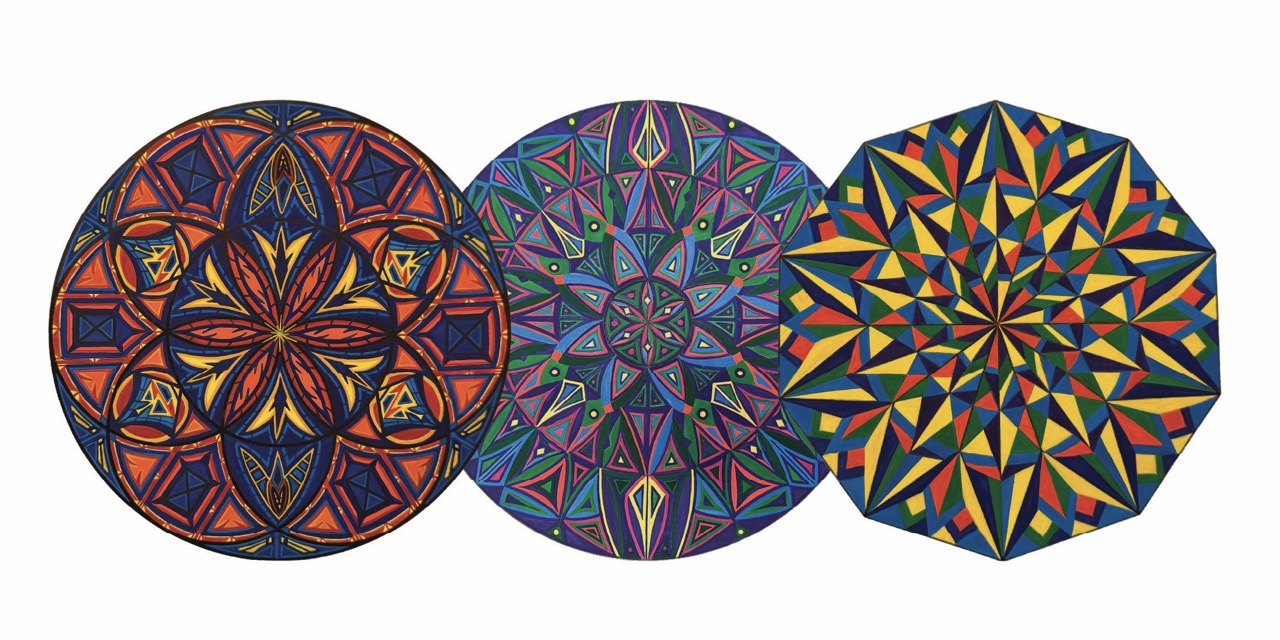
Un viaggio tra Colore, Geometria e Sacralità
Now On Display Until November 11, 2026
written by Costanza Maria Quintavalla
On Thursday October 15, the Palazzi Community Centre hosted the opening of the exhibition created by the association Firenze Alchemica. Visitors walked between colourful mandala artworks and spiritual iconographic figures, immersing themselves in an atmosphere of tranquility, conveyed by these art pieces.
Firenze Alchemica was born thanks to an idea, an intuition by vice president and mandala teacher Costanza Riva, later developed by founder Pier Giuseppe Valmore.
The company’s goal is to open the doors to a new art world that could inspire curiosity and show symbolic aspects of the city of Florence that go beyond historical perspective.
There are so many beautiful masterpieces around Florence that one could ask themselves if there is more than what the eye can see. And there is.
Experts that work at Firenze Alchemica guide the visitors through a hidden alchemic path inside the city, outlining a thread that links symbols to ancient alchemic art. This experience makes visitors see the place in its original form, preserving the creators intention.
This is how Firenze Alchemica thinks art is an endless source of questions.
Underneath the objective beauty, what does the artwork convey? What does it make the viewer feel? What can they see reflected within themselves?
In the past, the geometric figures composing mandala art were used as religious tools to reach the soul of the believers, via a harmonical repetition of colours and shapes.
One example is the geometric figure called “seme della vita”, found in the facade of San Miniato al Monte basilica, overlooking the entire city of Florence.
Mandala art is a form of meditation that connects the soul to the art. The colours within calm, convey tranquility and concentration.
While students learn the technical aspects, they also get in contact with the different meanings of colours. Teachers follow their progress, helping them create art they could be proud of, at the same time leaving them to find what they are looking for.
They initially colour the centre, focusing on a bulb of light in the page, slowly placing their own feelings and energy, spreading the pigments like rays of sun in the drawing.
Mandala teacher Costanza Riva emphasises this point stating “The outer colour matches the inner light one has inside of them. It becomes a mirror reflecting their soul.”
This harmony and engagement with the figures shows that a geometric image placed on a flat surface becomes a three dimensional type of art.
No one can make mistakes in mandala art, everything is appreciated as it is. And this is shown in the exhibition.
Even though they might have committed a “mistake” in the process, everyone deserves to be recognised for their hard work.
As Riva explained, “When someone feels unable to continue, insecure of their mistakes but do not give up on their art, that is when real art sparks, the true expression of oneself.”
The exhibition places Iconographic art opposite to mandalas, taking the eye of the spectator with its light and energy.
Iconographic art was born as a necessity in a period when most people were illiterate. It was an art developed by monks who reinterpreted the sacred religious texts through images to make their messages accessible to all. Images told stories of saints through symbolism, colours, technique and images.
Iconography involves an intricate process of manual work that from a simple canvas board and ends in a pigmented work of art with the icons as protagonist. The wooden tablet's surface is carefully smoothed, becoming a surface to spread out the glue they have previously made, all worked with the artist’s own hands. This becomes the base on which to place the linen layer on the top and then the colours.
Although it is demanding and challenging, this slow method helps with stress relief and concentration and in the end, shows the product of hard work.
Students who decide to undertake this path come in with curiosity and the need to find something to enrich their lives.
Teacher Serena Baldi reassures students that “Even though they cannot draw, have not had any previous experience with art, there is no need to be a Michelangelo. The question that matters most is if you feel the need and are eager to experiment something different. And if yes is your answer, then you should do it.”
One of the most important aspects of iconographic art is the choice of colours. Artists grind pigments and mix them, creating different colour tones. The make of colours becomes something personal as, creating a thing so powerful from nothing, improves the artist’s confidence in themselves and what they can create. Their energy transfers to the canvas.
“There is no precise quantity to make colours, it depends on what the person wants to portray and convey with their art. Every colour is different because everyone sees and feels in a different way. That is the world of colours.” says Baldi.
Iconography is a very particular world that can give a lot to the artist and the reader.
Today, not as many people are involved with religion, so why is this sacred art still alive, presenting religious symbols?
When students show up to a class, they are not questioned on their beliefs but on what passion and determination they put on these unknown subjects.
Baldi says “Painting is a language that is open to everyone. The concept is that,” she continues, “in all forms, photography, fashion, painting, art is something that unites.”
At the opening of the exhibition in The Palazzi Community Center, visitors could feel the passion of the devoted workers of the association Firenze Alchemica and their students.
In a few words by Vice President Costanza Riva, everyone who approaches Firenze Alchemica is “ are met with a group of people that live in equality and respect, providing support, friendship and great regard for one another.”
The concept that can be taken out from the entire presentation is that “Opera Alchemica transforms a block of lead into a beautiful gold ingot.” in Riva’s words.
If you have never attended an event like this before, do not worry. The Palazzi Community Center always offers something interesting to see or do. There are wine tastings, book readings, presentations and exhibitions. The Firenze Alchemica exhibition will stay in place until Wednesday November 11. Whether you are driven by curiosity or are already aware of the power of alchemic art, you will remain pleasantly surprised by the students' beautiful works of art exhibited in the hall. And maybe you will want to express yourself in the same way.
Latest news
Attend AUF's 15th Annual Conference This December
The American University of Florence invites scholars, researchers & academics to submit proposals to speak at next Fall's academic conference
DEADLINE EXTENSION: Symbiosis In Health Call For Papers
The American University of Florence and Fairfield University seek speakers for new health and nutrition conference coming this winter