


The American University of Florence invites scholars, researchers & academics to attend this December's academic conference
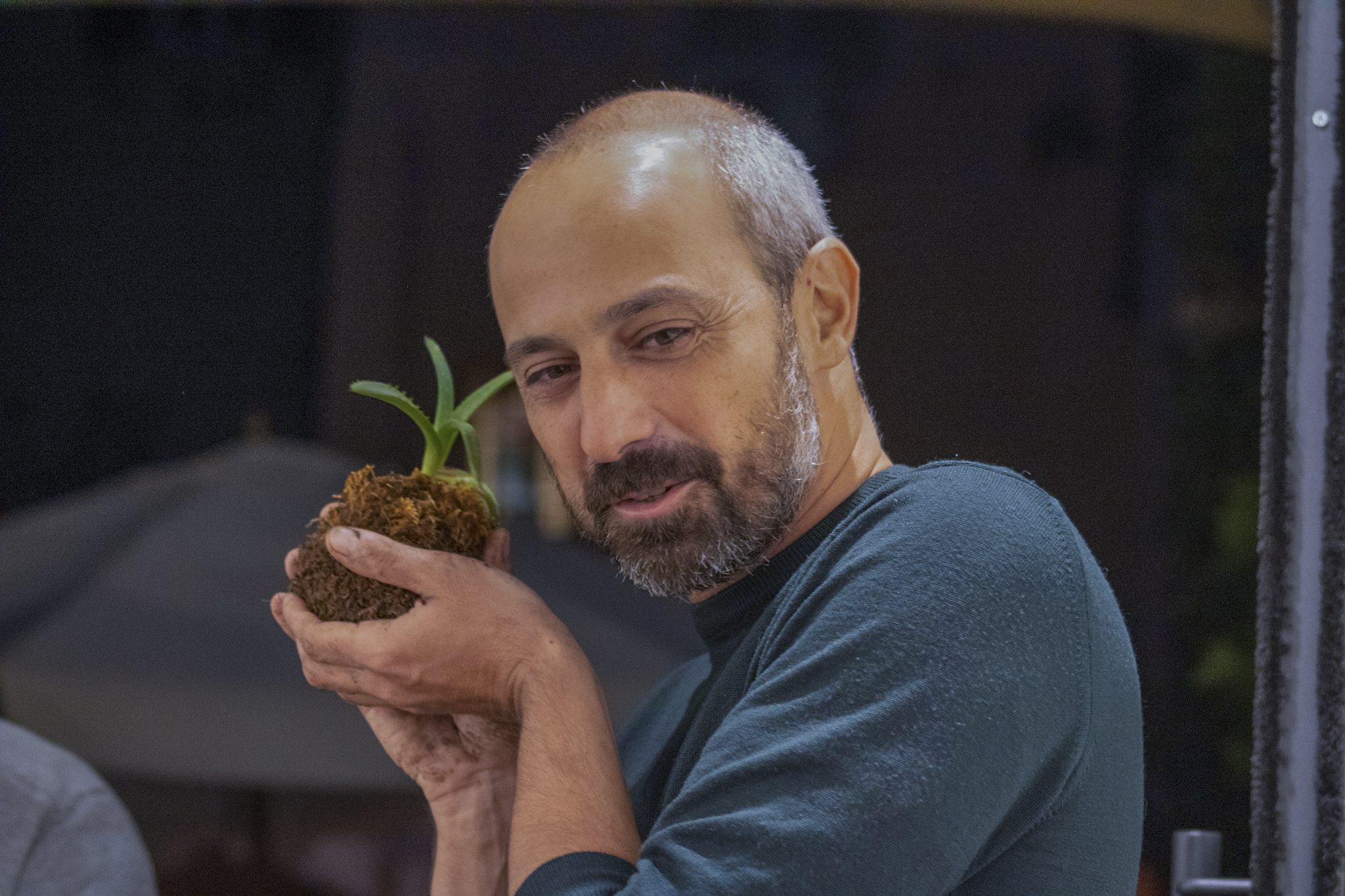
Botanica: "Impara l'arte giapponese del Kokedama"
Featuring Lapo Morgantini
written by Costanza Maria Quintavalla
On Thursday, October 29, AUF's Palazzi Community Center dedicated its space to host a botanical event presenting the Japanese art of Kokedama. The Kokedama art has passed onto generations from the Edo period in Japan, from the beginning of the 17th century. “Koke” means moss and “dama” means sphere, a composed name that already gives an idea of the materials used for its creation.
Three students of AUF Professor Lapo Morgantini’s gardening class decided to contribute to the presentation by bringing their passion for the philosophy behind the Kokedama and showing the simple steps to create this art.
The idea that made them choose Kokedama over other plants is its fascinating nature. It is an example of sustainability and simplicity, with a deeply rooted philosophy. Being together in the garden, close to this imperfect and spontaneous art, is an experience that gives a subconscious perception of its force and life.
In their own hands, they have a life that follows a completely different logic, its own growth, its space and its times. However, even from a distance the strong connection takes new forms and colors.
“It is not something we are accustomed to, plants speak a different language and through small gestures of care, we can learn the first language and words to communicate with them,” Morgantini said.
Kokedama is a minimalistic statue made of clay and moss with no glitz but a simple organic beauty. This living sculpture is meant to change and evolve over time. It has a verticality and a mobility that other plants do not have, teaching people to look at them as breathing and free beings, not restrained by the weight and rigid boundaries of the vase. It seems to float in the air like a green planet in the sky. As Lapo Morgantini emphasised, “even plants can fly and move as they please.”
While people engage with the plant, they can perceive its lightness and gentle nature, based on reciprocal care.
“We take care of them, they take care of us,” Morgantini said.
As the students explained, the Kokedama’s creation follows a few small steps. The first step to approach this art is looking intently around the city to spot and collect the moss, almost like a treasure hunt. Just like a sculpture, the second step includes getting your hands dirty, mixing clay and water to give shape to the small planet and creating your own round sculpture. Then, a plant of your choice is placed on top to make it all worthwhile. A flower, medicinal plant, aromatic plant or succulent plant all work to create the final result. This “pearl of moss,” so called but the students, is the support to the plant.
Everything is made of organic materials that will change or disappear over time. For example, the string that keeps this tennis ball-looking plant together will fade, leaving the moss and clay to self-support itself.
The pulsating hearth of Kokedama is its spirituality. It follows the concept of Wabi Sabi, a philosophy that encourages to see beauty in the roughness and its aging with the passing of time.
“For a very long time, people were forced to create something precise and perfect. The roughness and beautiful aging appearance were unintended and expected to come after its beauty faded,” said one of the students, almost like aging meant having an expiration date.
Wabi Sabi literally means “beauty of roughness” and “a character that develops with age,” and today it is a philosophy people search for and want to live by.
In Florence, we are used to seeing perfect Renaissance masterpieces made by the greats of the time. Everywhere we turn, beauty is controlled by numbers and algebraic proportions. One could think the Kokedama has nothing to do with the city and no place to fit in, but it is not true.
During the interview with Morgantini, he mentioned the cultural connection between Firenze and Japan, being Kyoto its twin city.
He says, “I noticed that there’s a lot of love and willingness to know Florence on Japan’s end and vice versa.”
The city of Florence tells a story of grandeur and gilded times, a time when architects like Brunelleschi, Michelangelo and Alberti used the classical rules of design, a repetition of geometric figures to display tranquility, equilibrium and quiet glory. The aspects of Kokedama tell a different story. A story that says that people can create beauty and elegance with very little, and can be imprecise, even in this city and overall in Italy.
Morgantini emphasises this point stating that in some parts of the south, “…there are these places that want imperfection and research aesthetics in crumbling and battered walls. This is valued as worthy and beautiful.”
There is an intrinsic worth and love of the city of Florence for the greenery and the techniques of gardening, as it is considered the “queen of Renaissance gardens” as Morgantini calls it. Even in these squared, structured gardens that convey balance and precise control over nature, there are few parts left untamed. They are left in the hands of nature, untouched by humans to let nature express itself without being manipulated. And this aspect is the reason why the Kokedama art has traveled continents and is so acclaimed in Florence today.
Kokedama shows that even imperfection is admirable and is a possibility to grow freely if left to nature. Lapo Morgantini reaffirms, “Imperfection is vital. It is life.”
It takes very little elements to create life. This can be observed in highly urbanised places like the side of the road and the cracks on the pavement. There, grass and plants grow unbothered, showing that no matter the environment, they are still there as a reminder that life can spark anywhere.
At the end of the presentation, students and the professor invited visitors to take part in the creation of the Kokedama. This activity showed Kokedama’s playful side and the lightness it brings to any spaces and people.
Kokedama plants can bloom and change the environment they are in, purifying the room through its release of oxygen and absorption of pollutants.
Whether you keep it inside as a minimalistic decoration to make the room breathe or outside planted in your garden, Kokedama is an independent plant that gives a lot. Anyone can create one, from kids to the elders. So, if you want to take part in any presentation like this one, register for the next events at Palazzi Community Center in Via Ricasoli, 21 or online today!
Latest news
Geometries of the Soul
Explore Giovanni Colazzo’s art, where geometry, duality, and creative freedom meet in his latest Florence exhibition.
A Palazzi Community Center Book Presentation
Explore Freddie Mercury’s life, music, and legacy through Maria Letizia’s "We Are the Champions" presentation at Palazzi Community Center.