


Attendees, both in-person and online, get a glimpse of AUF’s dynamic, culturally immersive environment at Open Day on November 13 & 14, 2026
The Artist Giancarlo Mariani
A Corridoio Fiorentino Guest Artist Exhibition
written by Connor Ondrak
The way one can utilize color is one of the most diverse and fascinating aspects of artwork. Warm colors such as red, orange and yellow can bring comfort and passionate feelings. While cool colors like grays, blues, and soft whites can bring melancholy and an introspective way of thinking.
For Giancarlo Mariani, color is a huge part of his process.
On his use of darker colors he said, “colors no longer have the meaning they had 100 years ago. I wanted to start over from zero. From the beginning. When a prehistoric man entered the cave, into the dark, and made marks.”
He utilizes blues and blacks to draw in emotion and to create a unique color palette to invoke specific emotions from people.
To Mariani, “black, as a meaning, has always been something unknown, something that can't be seen. Black represents mystery. That's why people often give it the meaning of fear - of death.”
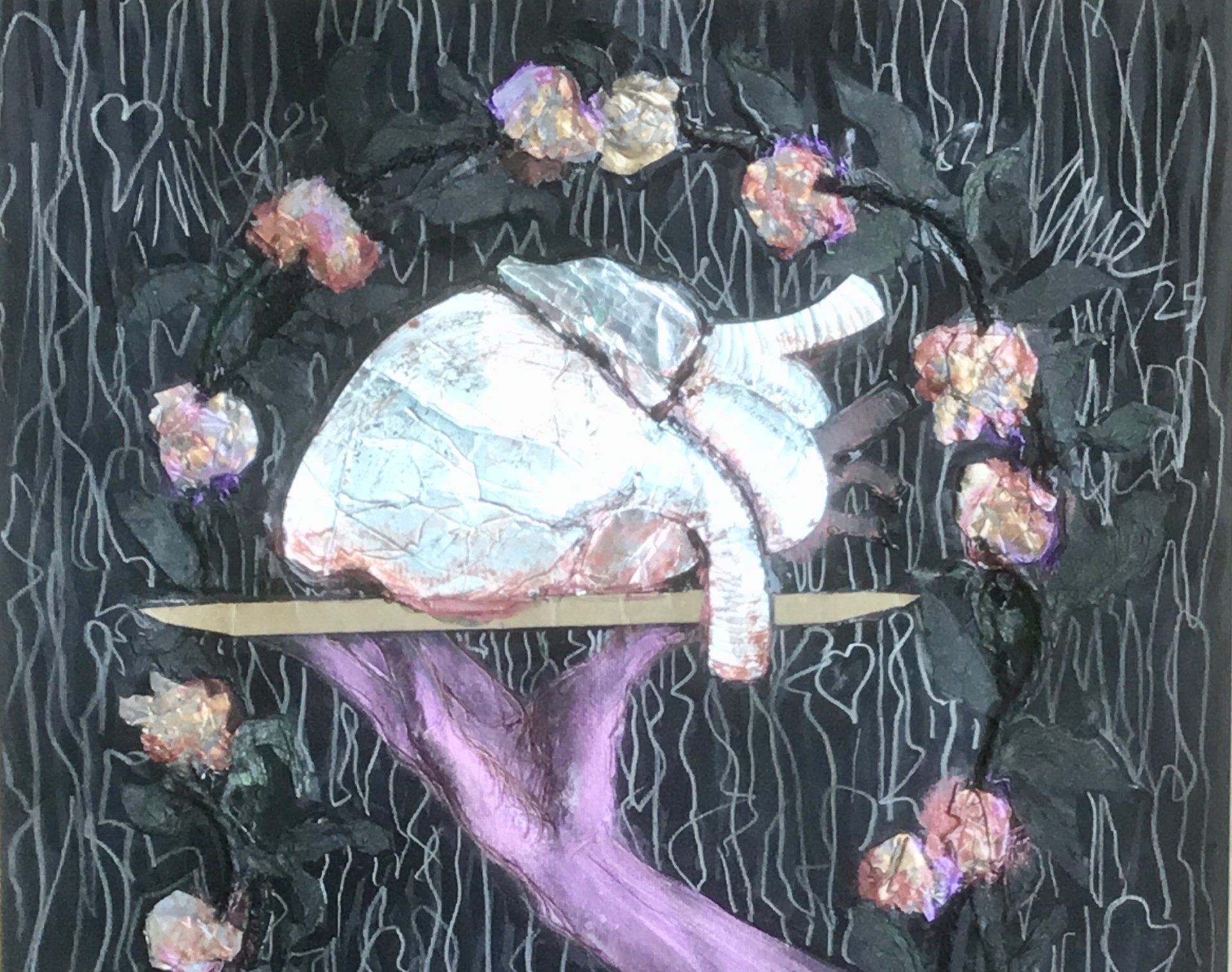
Besides color, the forms of his artwork focus on food and the human hands. He takes organisms and different parts of life and brings them into his cold melancholic world of cool blues, silvers, and blacks. To capture these specific harsh lines with his cool colors Mariani uses black pencils, pens, reliefs, glue, and often works on black cardboard. This is how he is able to achieve his scratchy and shadowy works.
One particular piece of his “Indica La Luna” or “I Point to the Moon” shows a hand grasping out in the darkness for the silver moon above. Surrounding this lone hand are dozens of others holding cellphones.
In his piece “Indica La Luna” Mariani pointed to an old saying of an Easter origin: “I point you to the moon, and you look at my dirty finger.” Because often, even when guidance is given, people don't look, they don't see. It's not easy to show things and make them understood.”
Mariani shares this in tandem with his use of black colors which already he finds people keep at a distance. For him and his use of these dark foreboding colors, he wants it to be an invitation to pay attention, and look beyond the more superficial parts.
In the “Indica La Luna” piece, a person is reaching out to something greater than them, they are reaching for the sky above, the moon above while everyone else is distracted by technology. This piece has a supernatural feel to it, and it's hard not to read a kind of longing for peace into the piece.
This piece is one of the several in Mariani’s Mar d'Agosto collection that can be seen at AUF's Palazzi Community Center from August 6th to September 16th. His artwork will remain up during this time for people to come and view.
Long before being featured in the community center, and before creating the “Indica La Luna” along with the others in this collection his relationship with art began when he was a child.
Mariani later attended the Institute of Art and Conservatory of Music in Florence. After this he became a set designer for theatres where he used his artistic prowess to design the backdrops in plays and provide visuals to bring these on stage stories to life. In 1997 he won a competition as a set designer at his theater which propelled Mariani to meet other artists and to collaborate with them. But it wasn’t until the COVID-19 lockdown that allowed for him to pursue his own individual projects which then led to his creation of this series of art pieces.
This particular series comes from his research into humility and darkness. Mariani is fascinated with the absence of color and he understands that this means using black and other darker shades with deep concentration to create contrasts and images that stand out. One of his other pieces titled “Fusilli Lunghi” is another piece that uses the same black pens, pencils and cardboard as are all the ones in this series. This piece depicts a pair of hands with forks getting spaghetti from a bowl.
Another piece from his collection that stands out is “Fragilita.” This piece follows his motif of hands reaching out to something, an idea of finding yourself in the darkness.
On the pieces' use of a broken flower and a whole one Mariani said “I always try to convey the idea of love, but not the banal kind of love found in songs, the kind you usually hear about. The flower, which is often associated with beauty, is associated with a kind of strength, but it's also something very delicate, something that must be respected.”
This artwork features two separate hands and arms. One with a flower that is upright and healthy and one with a snapped stem that is bent and wilted over. The hands are a translucent blue and it almost looks as if the stems of the flowers are cleanly digging into the arm - a joint venture.
His idea for this piece is and why one flower is broken is that “In this sense, fragility is an invitation to understand the meaning of having to respect something beautiful and delicate that can break, and that is therefore completely destroyed by the carelessness of whoever handles it. If you take a beautiful flower but throw it on the ground and step on it, it becomes nothing. It becomes dirt. It becomes garbage.”
Mariani's work, which is built almost entirely from black, silver, and blue finds the passion for life in his wilted world that he creates. The figures in his artwork are hands reaching out in the darkness for different aspects of the living. These aspects are food, nature, and the other parts that provide people with warmth. This series of work follows this idea that hands are our other set of eyes. When we can’t see, we use our limbs, we reach out and this holds meaning in the power of human touch and connection. His exhibit at the Palazzi Community Center offers a chance to stir with his dark worlds, and rather than look away he wants us to find the beauty in it.
Latest news
Attend AUF's 15th Annual Conference This December
The American University of Florence invites scholars, researchers & academics to submit proposals to speak at next Fall's academic conference
DEADLINE EXTENSION: Symbiosis In Health Call For Papers
The American University of Florence and Fairfield University seek speakers for new health and nutrition conference coming this winter