


Attendees, both in-person and online, get a glimpse of AUF’s dynamic, culturally immersive environment at Open Day on November 13 & 14, 2026
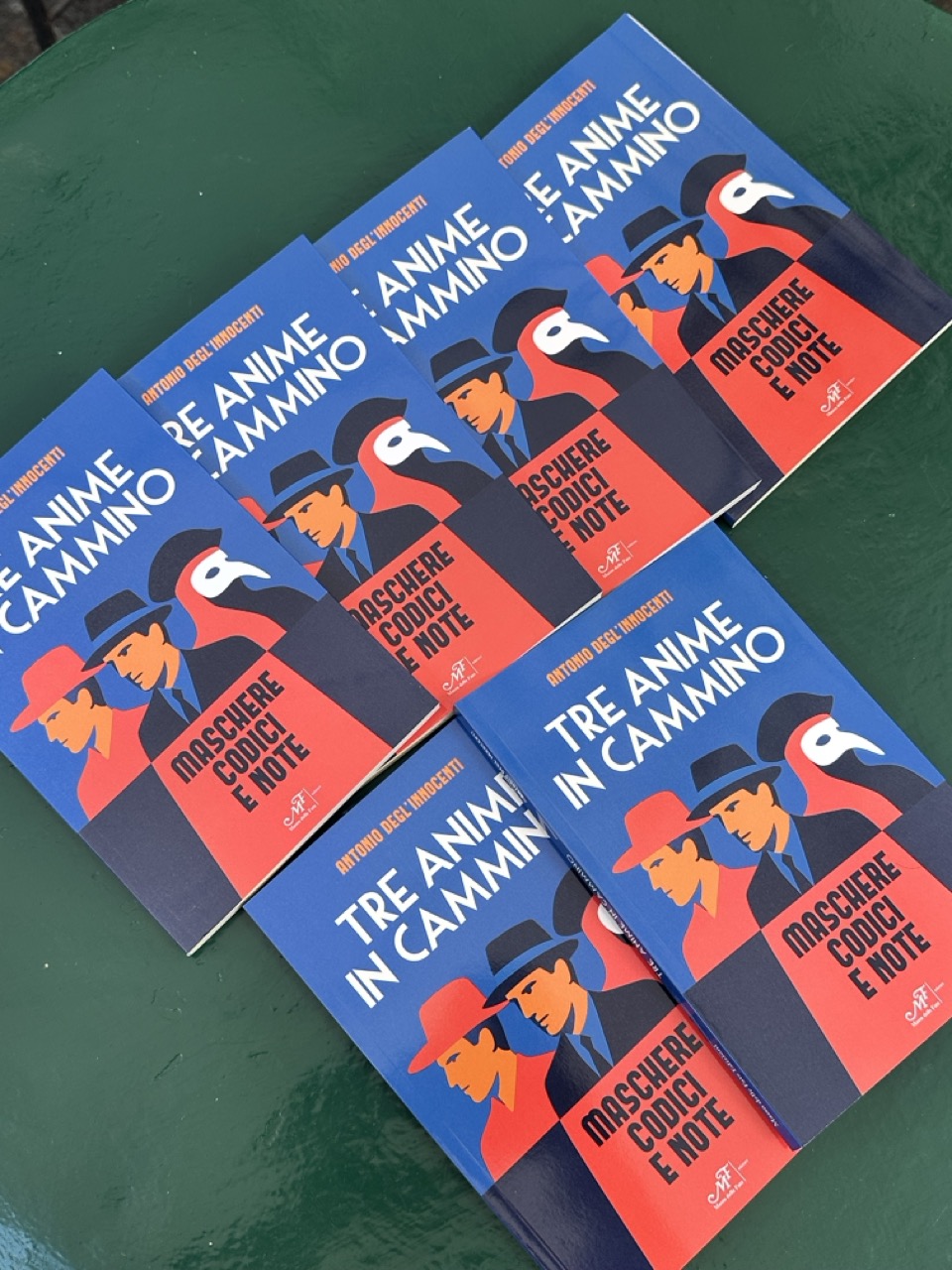
Antonio Degl’Innocenti on Tre Anime in Cammino
Passion, History, and Italian Identity
written by Emma Desmond, Mossimo Infante-Meehan & Sabrina Zabalaga
Italian author Antonio Degl’Innocenti’s book, Tre Anime in Cammino examines the lives of three individuals whose experiences connect to different aspects of Italian cultural and political history. Through the stories of Aldo Berti, Guido Brogelli and Bruno Tosi, the book explores postwar Italy, Cold War politics, cinema and opera while reflecting on how passion and adaptability shape cultural identity. The book draws from declassified FBI documents, the Venona Project and archives in Moscow to reconstruct Brogelli’s activities in the United States during the Cold War.
On Tuesday, May 26 Degl’Innocenti presented to an audience of local residents and students alike at The American University of Florence's Palazzi Community Center. Degl’Innocenti reflected on the inspiration behind the book, its relevance for international audiences, and the qualities he believes define Italian identity. He explained that the decision to bring together the stories of Aldo Berti, Guido Brogelli and Bruno Tosi stemmed from a desire to highlight individuals who pursued meaningful goals despite periods of uncertainty and hardship. According to Degl’Innocenti, contemporary society often places excessive value on economic and professional success, whereas the figures featured in the book exemplify a deeper sense of purpose, motivation and cultural commitment.
“In an era like ours — and I mean this on a global level — where passion seems to be fading because people are increasingly focused only on professional and economic goals, these three individuals show that even in moments of extreme difficulty, like during the Second World War, it is still possible to build something meaningful,” he said.
According to Degl’Innocenti, the stories are not centered on individual achievement alone. Instead, he views all three protagonists as people whose work contributed to broader cultural and social conversations.
“The goal should not be individualism. The goal is to build something for others as well,” he explained. “If you are motivated toward a meaningful objective, you also inspire and elevate the people around you.”
Although the three men worked in different fields, Degl’Innocenti believes they are connected through their determination and long-term cultural impact. Aldo Berti’s work in cinema, Guido Brogelli’s experiences connected to the Cold War and Bruno Tosi’s role within opera and Venetian cultural life all reflect forms of Italian influence that extended beyond national borders.
During the discussion, Degl’Innocenti was asked why stories like these remain relevant for international audiences today. He said that understanding history is essential to understanding the present.
“To understand what we want to do tomorrow, we must first be aware of what we did yesterday,” he said.
He explained that the protagonists of Tre Anime in Cammino are contemporary enough that their experiences still resonate in present-day conversations about freedom, cultural identity and postwar reconstruction. Aldo Berti’s story reflects Italy’s recovery after World War II and its return to international prominence in cinema and culture.
Degl’Innocenti said that despite the devastation Italy faced after the war, many Italians remained determined to rebuild through creativity and entrepreneurship. Guido Brogelli’s story, by contrast, turns more directly to Cold War history and the question of political freedom. According to a press release distributed via the Cold War Museum, Brogelli allegedly operated under the stolen identity of Peter Michelangelo Magrini while infiltrating the American aviation industry on behalf of Soviet intelligence. The release also references Brogelli’s connection to Julius Rosenberg during his detention in Brooklyn in 1951.
Degl’Innocenti said that researching Brogelli’s story changed some of his own views on American history and freedom of expression. He said he was surprised to learn that even during periods such as McCarthyism, people with opposing political beliefs still had opportunities to express themselves publicly in the United States.
“Your country defended freedom of thought, even during extremely tense moments in history,” he said. “That is not something everyone fully understands.”
He contrasted that with more restrictive political systems during the same period and said many Europeans do not fully recognize how strongly the United States protected freedom of expression during the Cold War. The international interest in Brogelli’s story has also led to discussion of a possible English translation of the book.
According to the press release, the author and publisher are seeking international partners interested in translating and distributing the work to American historians and researchers focused on Cold War studies. The final protagonist, Bruno Tosi, represents another side of Italian cultural history through opera and Venice’s artistic identity. Degl’Innocenti described Tosi’s connection to Venice as deeply personal and said his passion for opera became central to his work and public legacy.
When asked whether he found a common definition of “Italian excellence” while writing the book, Degl’Innocenti pointed to adaptability as one of the defining characteristics of Italian culture.
“I discovered what I would call the Italian ability to adapt,” he said.
He connected that idea to Italy’s postwar recovery. Despite the country’s political and economic struggles, Italy later gained international recognition through companies such as Ferrari, Lamborghini, Piaggio, Ferragamo and Olivetti.
Degl’Innocenti said this ability to rebuild and reinvent under difficult circumstances has become an important part of Italy’s national identity. He also emphasized the long-standing cultural relationship between Italy and the United States, particularly through cinema, fashion and opera.
Throughout the discussion, Degl’Innocenti returned to the themes of historical memory, motivation and cultural exchange. Through Tre Anime in Cammino, he presents not only the stories of three individuals, but also a broader reflection on how personal determination and cultural identity continue to shape historical understanding across generations and countries.
Latest news
Attend AUF's 15th Annual Conference This December
The American University of Florence invites scholars, researchers & academics to submit proposals to speak at next Fall's academic conference
DEADLINE EXTENSION: Symbiosis In Health Call For Papers
The American University of Florence and Fairfield University seek speakers for new health and nutrition conference coming this winter