


Attendees, both in-person and online, get a glimpse of AUF’s dynamic, culturally immersive environment at Open Day on November 13 & 14, 2026
‘Transform Into Yourself’
Andrea Mati shares his mission to heal through nature at the Palazzi Community Center
written by Laurel Swanz
Andrea Mati, fifth-generation landscape architect for his family’s company Giardini Mati 1909, doesn’t just build gardens to win design awards. He builds them to survive — and to help others do the same.
Decades before he became internationally renowned for designing therapeutic green spaces, Mati found himself knee-deep in soil, nursing "discarded" plants back to health as a way to battle his own deep depression.
“Depression has been a problem in my life that's led to some very difficult times,” Mati told a crowd of students and Florence locals at the Palazzi Community Center (PCC) on April 27. “But we have this wonderful place, going to my family's nursery, so I can maybe take those plants that were thrown away, and put them back in a small pot, water them, fertilize them, to give me life again too.”
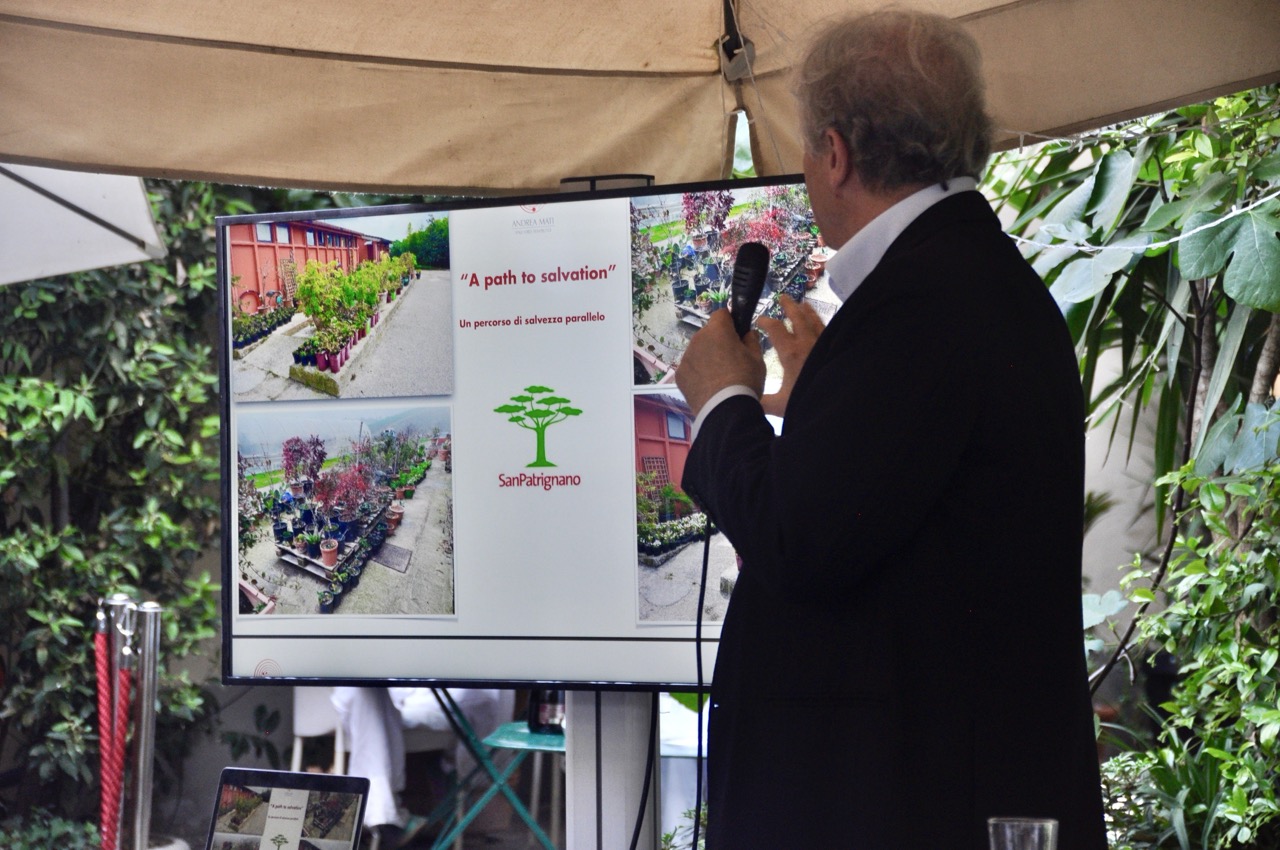
A continuation of the PCC’s “Made in Florence” series, Mati shared the story of how this revelation turned into an international movement.
“So since I too had come back to life, at that point I thought that perhaps I could share this with many people who were suffering and not just keep it to myself,” Mati said.
At 20 years old, Mati began reimagining his family’s business to go beyond building “normal” gardens, based on his belief in the transformative power of nature. Over four decades, Mati designed hundreds of therapeutic gardens across Italy, Spain, Switzerland and Portugal.
The spaces are a result of years of collaborative research between Mati, mental health specialists and doctors, catered specifically to different mental afflications, including autism spectrum disorder, depression, anxiety, eating disorders, memory and cognitive disorders, and more.
At the “Made in Florence” event, Mati shared images of the spaces he creates, statistics about their success and the science behind the connection between green spaces and mental health.
Mati said that the modern surge in anxiety and depression is largely due to a "progressive distancing from nature” and a tendency to become “slaves to technology.” He views plants not as aesthetic objects, but as partners in a "mutual care" process.
Those who visit Mati’s gardens are invited to become active participants in maintaining their beauty. By tending to the land, Mati said they can unplug from their struggles and find the same path to self-transformation that he did.
“Transforming into ourselves means truly connecting with who we are and truly doing what we want. If we do that, many problems will pass,” Mati said.
Mati said that a significant portion of his work has focused on helping those recovering from addiction, specifically in his own city of Pistoia, where he transformed a square that was once a notorious drug-dealing hub into a garden.
"I thought it could be nice to create a garden in a place of drug dealing with the kids who bought drugs there and transform this place,” Mati said. “Here, the empowered person who is being treated for addictions feels a great sense of responsibility and therefore greatly improves his or her psychological journey in the community.”
Mati highlighted this project as a "strong signal" that greenery can reclaim even the most marginalized and dangerous urban spaces.
He said seeing the space, and most importantly the people, living up to their fullest potential because of his efforts, has been the “best experience in life.” Mati encouraged the crowd to seek this satisfaction of helping others in whatever they do.
“Get involved, get indignant, cry. Don't just stand there and watch the world go by,” Mati said. “Throw yourself into life, work, be aware of your neighbor. If they're sick, make an effort. If you can, give them a hand.”
After spending 40 years helping others "save" themselves through greenery, Mati said he feels like his truest self, free from the depression that once held him hostage.
“The best compliment I've ever received was from a childhood friend of mine,” Mati said. “He saw me devote myself so much in recent years to helping people suffering in the countryside, working alongside doctors. He said, ‘Well done, you're finally transforming into yourself.’ I'm transforming into myself. Little by little I've made it.”
*All quotes in this article have been translated from Italian
Latest news
Attend AUF's 15th Annual Conference This December
The American University of Florence invites scholars, researchers & academics to submit proposals to speak at next Fall's academic conference
DEADLINE EXTENSION: Symbiosis In Health Call For Papers
The American University of Florence and Fairfield University seek speakers for new health and nutrition conference coming this winter