


Attendees, both in-person and online, get a glimpse of AUF’s dynamic, culturally immersive environment at Open Day on November 13 & 14, 2026
"When Women Use Their Heads” Highlights the Hidden History of Female Inventions
A Palazzi Community Center La Botanica Event
written by Sabrina Zabalaga, Emma Desmond & Mossimo Infante-Meehan
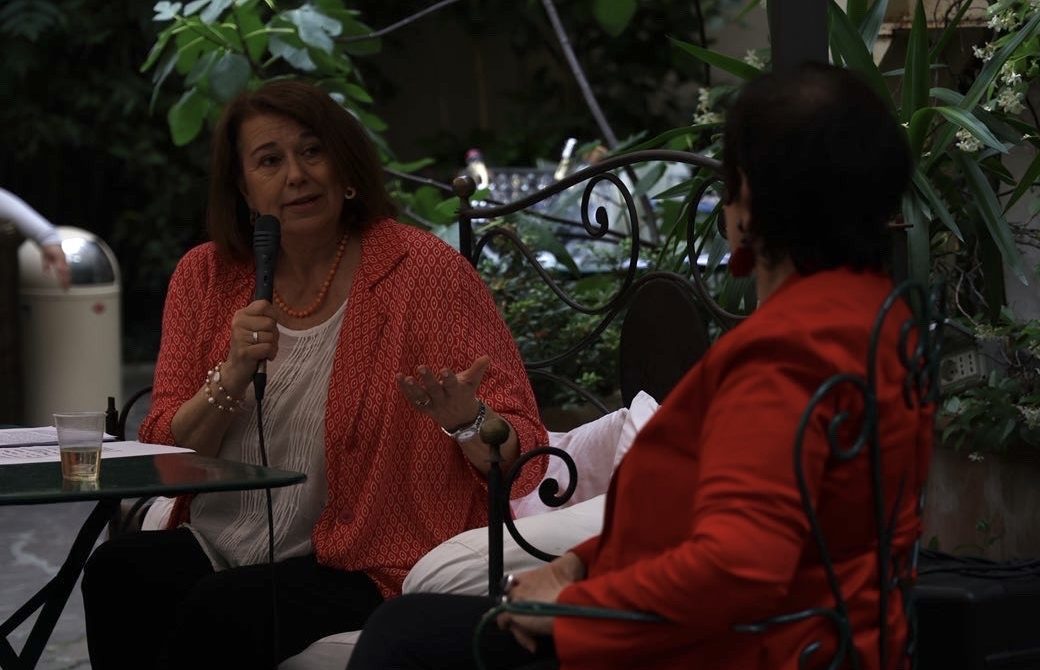
Florence, Italy May 28 - The American University of Florence's Palazzi Community Center hosted the cultural event “When Women Use Their Heads”: A Brief History of Female Inventions, featuring author Elisabetta Failla and moderated by Nicoletta Arbusti. The event offered a thoughtful and engaging look at the history of women inventors and innovators, which is often overlooked; encouraging the audience to rethink how women’s contributions to everyday life, technology and science have been remembered.
The discussion portrayed the ways women have shaped history, highlighting their invention, creativity and persistence when society did not always recognize it as contributive work. With rich and thorough examples and reflections, Failla challenged the traditional narratives that have often placed women in the background of our world's progress. The event connected more historical facts with contemporary awareness, revealing how learning and discussing women's achievements remains highly relevant today.
As part of Palazzi Community Center’s La Botanica series, the event engaged in open discussion about innovation and recognition. The moderator, Nicoletta Arbusti helped guide the conversation with the author and the audience, helping to create an atmosphere where education and participation was sought out.
After the event concluded, Failla revealed through an interview that her interest in women inventors stems from a desire to challenge the stereotypes on women’s abilities. She stated women have often been viewed as “the weaker sex” and were expected historically to only focus on home activities such as family care and cooking. According to Failla this limiting view ignored women’s intelligence, creativity and ability to solve problems.
Failla was passionate and emphasized that women are capable of doing everything a man can do, and history proves it. She noted that especially after the First Industrial Revolution women first began entering the workforce. It was considered unconventional and outside normal social behavior at the time.
However, this shift gave women a major revolution. It was an opportunity that they took advantage of to step outside the traditional expectations and to begin flourishing in a space where they had previously been excluded.
One of the strongest messages emphasized in the interview was the importance of courage. Failla explained how courage is necessary for women who want to do something different or challenge the stereotypical roles assigned to women. Her interview connected the stories of women inventors to a stronger message on independence, resilience and the need to keep pushing limitations even in today's society.
When asked about women or inventions that stood out and inspired her, Failla stated examples of American women who invented everyday items such as the washing machine, the mop and the paper bag. She also referenced Hedy Lamarr, whose ideas contributed to the creation of wireless communication.
These examples show that women’s inventions were not minor contributions. They changed how people live everyday.
Failla explained further that these women inspired her personally. Their stories and many others inspired her to continue improving her own work and have the courage to do something different. She said her own professional path is one that developed over time. Starting as a writer and later continuing to public speaking and television, her experience displays the same values she shared during the event; that women can continue to evolve and take risks in order to create new opportunities for themselves.
The event also addressed the problem of equality in recognition. Failla explained that many women contributed to major ideas and inventions, but were left behind the scenes with a man to take place for their findings. Work was not always properly credited. Their names were constantly not included from the historical record. By discussing these women publicly, Failla’s goal is to give them a voice, and help audiences find value in their discoveries.
Failla said she hopes her viewers and audiences left the event, having learned something new, and having “met” special women through their stories. She aims for people to recognize that many important contributions were made by women whose names are not known. Her goal is to pull these figures out of the dark and into public awareness.
Additionally, the event successfully positioned the university's Palazzi Community Center as an environment for cultural education and meaningful dialogue. The topic was accessible to a broad audience because it leveraged historical examples with current society on equality. By hosting this event, PCC facilitated discussion that was not only informative, but socially relevant.
Overall, “When Women Use Their Heads” created a space for reflection on how society remembers and broadcasts women’s work and how public conversations can help correct that imbalance. Through Failla’s research, the audience was reminded that women have always been inventors and contributors to progress.
The event left the audience with a clear message: women’s achievements deserve and need to be recognized, shared and celebrated in order for society to keep evolving and growing. By revisiting the history of female inventions, Elisabetta Failla engaged with the community to look at the past with better awareness and to carry that recognition into the present and future.
Latest news
Attend AUF's 15th Annual Conference This December
The American University of Florence invites scholars, researchers & academics to submit proposals to speak at next Fall's academic conference
DEADLINE EXTENSION: Symbiosis In Health Call For Papers
The American University of Florence and Fairfield University seek speakers for new health and nutrition conference coming this winter